The Difference Between a Croissant and a Danish: A Laminated Pastry Guide
There is a moment at a bakery counter when everything looks equally good, and you are not entirely sure what to order. The croissant is familiar. The Danish looks beautiful. The pain au chocolat is calling your name. They all come from roughly the same tradition, but they are not the same thing, and understanding the difference between them changes how you order, what you expect, and how much you appreciate the work that went into what is sitting in that case.
This is a guide to laminated pastry: what it is, how croissants and Danishes differ, and what to look for when you are standing in front of a well-stocked bakery counter in Baltimore.
What Is Laminated Dough?
Every croissant, Danish, and pain au chocolat starts with the same foundational technique: lamination. It is the process of folding butter into dough repeatedly, creating dozens of distinct layers that separate and puff during baking. The result is that characteristic flakiness, the visible layers, the shatter of a good crust, and the open, honeycomb interior that makes a well-made pastry so different from ordinary bread.
The technique is time-intensive. The dough needs to rest between folds to keep the butter cold and the layers intact. Rush it, and the butter melts into the dough rather than staying separate, and you lose the layers entirely. A bakery that laminates dough properly has committed real time and skill to the process before a single pastry goes into the oven.
That foundation is what croissants, Danishes, and pains au chocolat share. What separates them is what happens next.
The Croissant: Technique on Display
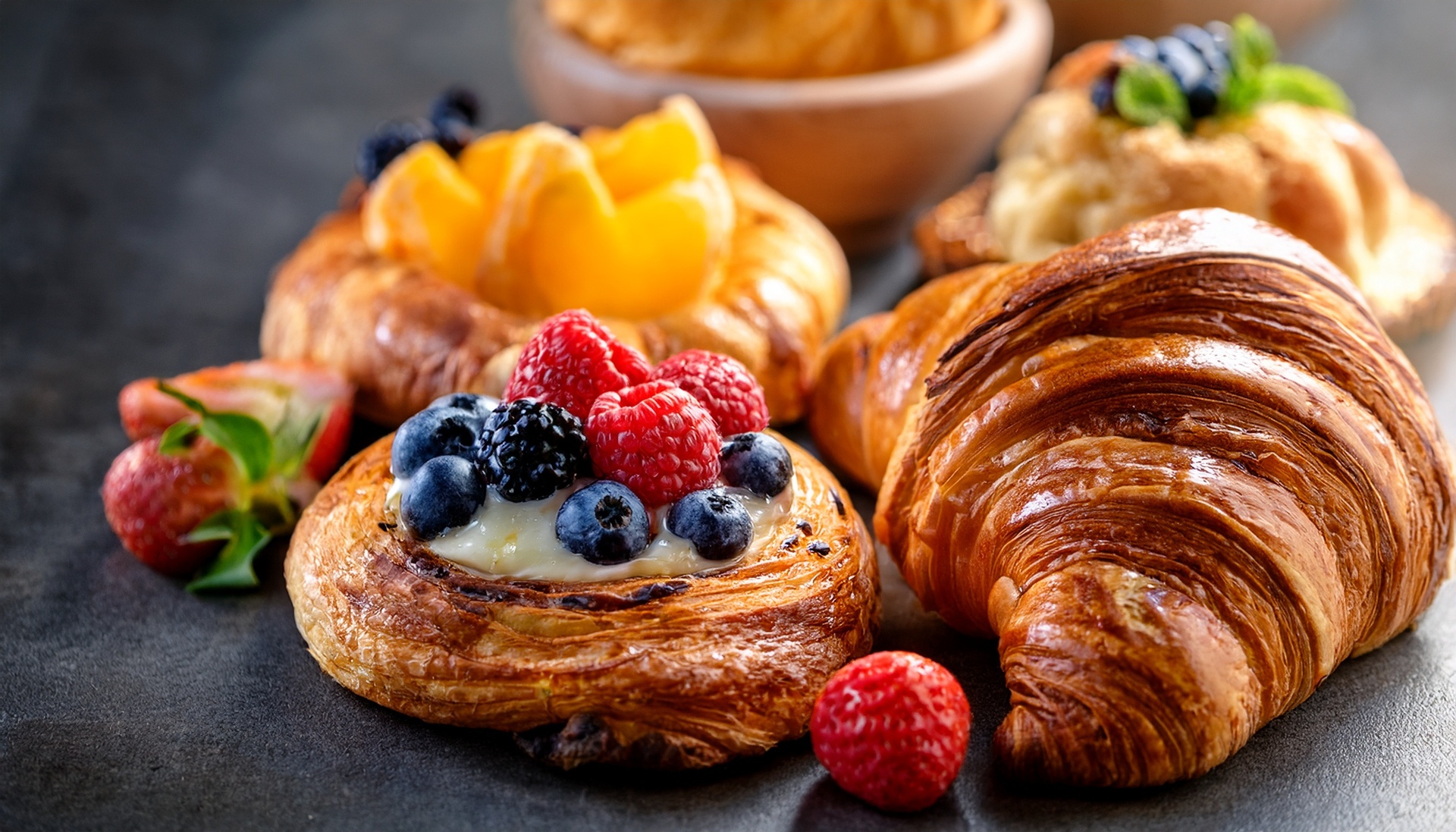
A croissant is laminated dough in its purest expression. The dough is rolled and shaped into its familiar crescent, then baked until the outside is deeply golden and the layers inside have separated into something light and almost architectural.
A good croissant has a crust that resists slightly before it gives. When you pull it apart, the interior should be open and slightly chewy, with visible layers that pull away from each other cleanly. The flavor is almost entirely about the butter, the quality of the flour, and the fermentation of the dough itself. There is nothing to hide behind, which is what makes the croissant the clearest test of a bakery’s lamination skill. If the croissant is good, the rest of the laminated pastry case usually is too.
Plain croissants are the standard. Almond croissants take a day-old plain, soak it lightly in syrup, fill it with almond cream, top it with sliced almonds, and bake it a second time. The result is richer and softer than the original, with a sweetness that makes it a different eating experience entirely rather than simply an embellished version of the same thing. A pain au chocolat uses the same base dough shaped as a rectangle folded around one or two pieces of dark chocolate. The chocolate melts into the interior during baking and pools slightly at the center.
Each of these is a variation on the same foundation, but each has its own distinct character.
The Danish: Richer, Softer, Built for Fillings
A Danish starts from a similar laminated dough but is made with a more enriched recipe, typically more eggs and sometimes a touch more sugar worked into the base. The result is a dough that bakes up softer and slightly more tender than a croissant, with less of the dramatic flake and more of a pillowy, layered pull.
That difference in texture is what makes a Danish such a good vehicle for fillings. The structure holds up to fruit, cheese, cream, and custard in a way that a croissant, with its more delicate interior, does not. A fruit Danish with stone fruit in late summer or spiced apple in fall sits differently in your hand than a croissant does. It is more substantial, more yielding, and built for a slower kind of eating.
Cheese Danishes, filled with lightly sweetened ricotta or cream cheese, are one of the most reliable orders at a bakery that makes them well. The filling should be barely sweet and smooth, not heavy or cloying. A fruit Danish worth ordering uses real fruit rather than commercial jam, and the topping should reflect what is actually in season. Morning buns and kouign-amann occupy related territory, using enriched or laminated dough in ways that result in a caramelized exterior and a dense, chewy interior. If a bakery makes either of these, they are worth trying even if they are unfamiliar.
Pain au Chocolat: The Case for Getting It Right
Pain au chocolat deserves its own moment because it is one of the most frequently ordered and most frequently disappointing items in a bakery case. When it is made well, it is one of the better things you can eat in the morning. When it is made carelessly, it is a croissant with a piece of chocolate inside and not much else.
The difference comes down to a few things. The chocolate matters: a good pain au chocolat uses dark chocolate with enough bitterness to hold up against the butter in the dough, not a sweetened filling that disappears into the background. The lamination matters, with the same standards that apply to a plain croissant applying here. And the baking matters: the chocolate should be fully melted and slightly pooled at the center, not still in chip form when you bite in.
If you are searching for pain au chocolat nearby in Baltimore, the thing to look for is a bakery that makes its laminated pastry in-house each morning. That detail is the biggest separator between an exceptional version and a forgettable one.
What to Order and When
The plain croissant is the best starting point at any bakery. It is the clearest test of technique, and if it is good, almost everything else will be too. Order it first before you work through the rest of the case.
An almond croissant is a good choice when you want something more substantial. It pairs well with a black coffee or espresso and is best earlier in the day before the filling has had time to soften the pastry further. A pain au chocolat rewards the same early timing, when the chocolate is still soft at the center and the crust still has some resistance.
Fruit Danishes are best in season. In fall, apple, pear, and fig fillings are at their strongest, and a well-made fruit Danish is one of the more satisfying things on a bakery menu when the fruit is good and the dough is fresh. Cheese Danishes work any time of year, with the quality of the filling being everything. A clean, lightly sweet ricotta or cream cheese center is the benchmark worth holding to.
Finding Danish Pastries and Laminated Pastry in Baltimore
Baltimore has a growing number of bakeries doing serious laminated pastry work. What separates the best from the rest is almost always the same thing: in-house production, daily baking, and a commitment to the time the process actually requires.
Kneads Bake Shop builds its pastry case around that standard. Fresh pastries baked each day, a menu that reflects seasonal ingredients, and a counter where what you pick up in the morning was made that morning. Find a Kneads location near you to see what is in the case, or order fresh pastries online if you want to plan ahead.
Frequently Asked Questions
What is the difference between a croissant and a Danish?
Both use laminated dough, but a Danish is made with a more enriched recipe that results in a softer, more yielding texture. Croissants are flakier and more delicate, built for butter and technique to do the work. Danishes are designed to hold fillings like fruit, cheese, and cream without losing their structure.
What makes a good pain au chocolat?
Quality dark chocolate, proper lamination, and correct baking time. The chocolate should be fully melted at the center, the crust should have resistance, and the interior layers should be open and light. A pain au chocolat made from good croissant dough with quality chocolate is a different product entirely from a standard version.
Where can I find Danish pastries in Baltimore?
Look for bakeries that produce their laminated pastry in-house each morning. Kneads Bake Shop is a good starting point, with fresh pastries available across its Baltimore locations. Arriving early gives you the best selection before popular items sell through.
Are almond croissants made from fresh or day-old croissants?
Traditionally, almond croissants are made from day-old croissants that are soaked in syrup, filled with almond cream, topped with sliced almonds, and baked a second time. The process transforms a croissant that has lost some of its initial freshness into something richer and more substantial.
What is kouign-amann?
Kouign-amann is a Breton pastry made from bread dough that is laminated with butter and sugar. During baking, the sugar caramelizes to form a crisp, lacquered exterior around a dense, chewy interior. It is richer and more intensely flavored than a croissant and worth trying at any bakery that makes it well.
The Pastry Case Is Worth Your Attention
A well-stocked laminated pastry case at a good bakery rewards the time you spend in front of it. The croissant and the Danish come from the same tradition but offer completely different experiences, and the variations between them, almond, chocolate, fruit, cheese, each add another layer worth exploring.
Start with a plain croissant to test the technique, then work your way through the case from there. Stop into Kneads Bake Shop and see what came out of the oven this morning.